When you buy through links on our articles, Future and its syndication partners may earn a commission.

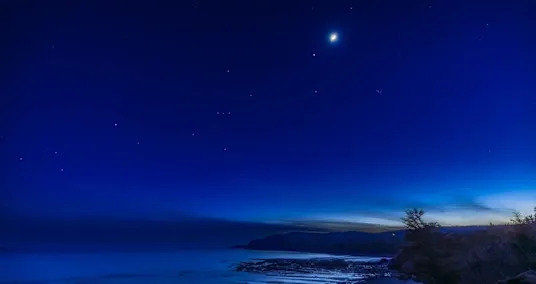
Look to the east at sunset tomorrow (March 26) to see the half-lit form of the waxing gibbous moon shining close to the gas giant Jupiter in the evening sky, as the bright stars of the constellation Gemini twinkle nearby.
The moon will make its closest approach to Jupiter at 9:19 EDT (1319 GMT) on March 26, at which time Jupiter will be lost to sight in the daytime sky. The pair will remain close throughout the evening, however. Viewers in the northern hemisphere will get their best view of the solar system pairing at sunset, when the moon will appear with its right side lit by sunlight high above the southern horizon, less than a day after reaching its first quarter phase.
Jupiter will appear as a steady star-like object glowing brightly 5 degrees to the lower right of the lunar disk — roughly the width of your three middle fingers held at arm's length against the sky. To the upper right shine Castor and Pollux — the bright stars that represent the heads of the celestial twins depicted in the constellation Gemini.
The moon and Jupiter will make for a gorgeous sight through the eyepiece of a 6-inch telescope, which will reveal the dark lunar seas and prominent craters lining the night-day divide on the lunar surface, along with the cloud bands of the gas giant and its most prominent moons.
As the night wears on, the lunar disk will appear to travel away from Jupiter in Earth's sky, before finally disappearing from view below the northwestern horizon shortly after 3 a.m. EDT (0700 GMT) for viewers in New York. Visit Time and Date to discover the exact times that solar system bodies like the planets rise and set from your location.
Jupiter is set to remain a prominent sight in the spring sky until mid-July, when it will become lost into the glow of the setting sun ahead of its solar conjunction on July 29, according to in-the-sky. At that time, Jupiter will be too close to the sun from our perspective on Earth to be visible.
Want to get a closer look at the moon and Jupiter? Then be sure to check out our picks of the best telescopes and binoculars for exploring the night sky. If you're into photography then you may also want to read our picks of the best cameras and lenses for astrophotography, along with our roundups of the finest smart telescopes available in 2026.
Editor's Note: If you would like to share your astrophotography with Space.com's readers, then please send your photo(s), comments, and your name and location to [email protected].
LATEST POSTS
- 1
 Council removes proposal to rename park named after former president of Israel
 - 2Cyprus: War-related tourism concerns and climate change efforts
- 3They grew up with 'almond moms.' Now, they dread going home for the holidays.
- 4Russia earning billions from Hormuz blockade, German trade body says
- 5I read 115 books this year. 'Wuthering Heights,' 'Heart the Lover' and 'The House of My Mother' were among my 10 favorites.





- 23 Most Amusing Messages At any point Sent Among Youngsters and Their Folks
- FDA adds strongest warning to Sarepta gene therapy linked to 2 patient deaths
- Explainer-What Novo Nordisk's weight-loss pill approval means for company, patients
- Analysis-NASA's moon mission tests aerospace old guard as SpaceX, Blue Origin hover
- Over 1,800 killed since junta seized power in Burkina Faso, rights group says
- Instructions to Explore the Therapy Choices for Cellular breakdown in the lungs
- African Forests Have Become a Source of Carbon Emissions
- New movies to watch this weekend: See 'The Running Man' in theaters, rent 'One Battle After Another,' stream 'Nobody 2' on Peacock
- Cuba says 33 have died of mosquito-borne illnesses as epidemic rages